

I am a fan of Nathan Bush’s ADD TO CART Podcast series.
My main issue: I just do not have enough time to listen to all the episodes (guilty, I know)!
Some of my personal favourites are:
– YC EU from Nespresso | #511
– Modernising Health eCommerce: Suzie Young, Head of Digital ANZ, on the Six-Month Metagenics Transformation | #506
– The B2B Revolution: How Brett Sinclair is Empowering Retailers for Growth | #487
– The Next Evolution of Online Shopping: Shopify’s AI-Powered Future with James Johnson | #524
When time becomes a challenge, I was trying to figure out a way on how I can keep up with Nathan’s amazing production value and at the same time train my own little AI project. What you are reading right now is the outcome of this effort.
A key call out is the intended mix of AI capabilities and my own writing for this post. I am trying to call it out explicitly, as the intention is not to pass some of the agents outcomes as my own. All of the analytics work, review of themes and core summaries you see in this blog are exclusively created by these above “Agents”. If you feel anything “feels” like AI > it is.
My approach
Turn to an Agentic framework to create a fully reproducible podcast-analysis pipeline by programmatically extracting 104 Add To Cart episodes (2025) using:
Topline AI Capabilities
- Claude 4.5 Opus – Analytics modeling, data interpretation, and insight extraction
- Google Gemini Pro – Image processing logic and visual composite generation
- Manus 1.6 – Agentic workflow orchestration and auxiliary task automation
- OpenAI ChatGPT 5.2 – Core code framework generation and architectural scaffolding
- Perplexity Pro – General research
Detailed Capabilities:
- collections (stdlib) – Counter for word frequency aggregation
- faster-whisper – Local speech-to-text transcription (Whisper ASR, CPU-optimized)
- feedparser – RSS feed parsing for episode discovery and metadata extraction
- ffmpeg – Audio decoding, conversion, and probing (via ffprobe)
- matplotlib – Data visualization and image rendering
- pandas – CSV handling, metadata normalization, and pipeline orchestration
- Pillow – Image processing, high-quality resizing, and composite generation (via PIL)
- pip – Python package installation and dependency management
- pydub – Audio slicing, normalization, and snippet extraction
- Python 3.12 – Primary runtime environment
- re (stdlib) – Regex pattern matching for quote/guest extraction
- requests – HTTP client for RSS fetching, audio downloads, and image retrieval
- virtualenv (
venv) – Isolated Python environment management - Visual Studio Code – Integrated development environment (IDE)
- Windsurf – Agentic integrated development environment (IDE)
- wordcloud – Word cloud generation from term frequency data
1 Year Worth Of Data (*no guarantee for completeness)
Let’s start with some overview: in 2025, Add To Cart published a total of 104 Episodes.
Total Word Count: 639,000 words
Total Characters: 3,475,000+
Average Words/Episode: 6,144 words
Estimated Total Play Time: 71 hours (!!!)
Average Episode Length ~41 minutes
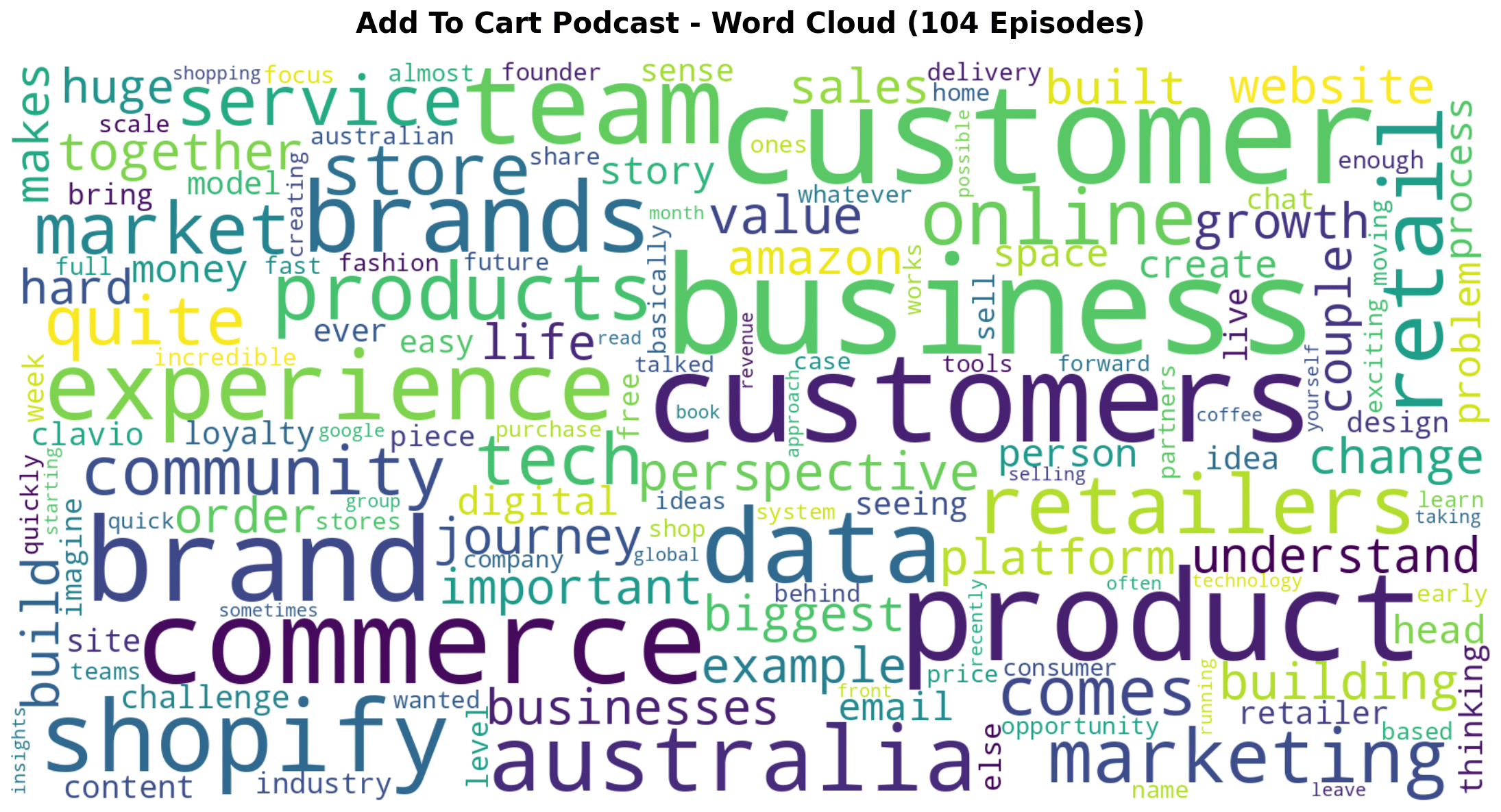
- “Customer” appears 2,664 times — the podcast is deeply customer-centric
- “AI” is mentioned 698 times — that’s ~7 mentions per episode, showing how dominant this topic has become
Some memorable quotes (all hand picked by the agent):
“I have a strong growth mindset. Evolution is my purpose. So the minute I get into a room and meet people, I’m like, I have to pick your brain. There’s so much I want to know.” – YC Eu
“I’m a bit like a drug dealer with the old magnesium — I’ve got all my friends and family on it. If you’re not on magnesium, you should be taking magnesium. That’s the hot tip.” – Suzie Young
“I call myself a reformed retailer. I studied a Bachelor of Electronic Commerce in 2001 — which marks me as a geriatric millennial. But I have a deep, deep true passion for commerce, and Shopify’s mission is about making commerce better for everyone.” – James Johnson
“People have cathartic experiences when they can chat with someone experiencing the same pain as them. These B2B guys just don’t get the opportunity to meet many other people going through what they’re going through.” – Brett Sinclair
A Summary In 10 Themes (all AI generated)
- Commerce maturity is assumed
- Differentiation has moved behind the interface
- Technology is treated as an amplifier, not a strategy
- Scale is a governance problem before it is a growth problem
- Measurement shapes behaviour more than strategy
- The real complexity lives in the seams
- Operations increasingly are the customer experience
- Experience has become emotional as well as functional
- Complexity can be a moat, if it is priced honestly
- Longevity outranks optimisation
1. Commerce maturity is assumed
No one explains ecommerce anymore.
There is almost no time spent justifying digital channels, omnichannel strategies, or platform choice. These are treated as environmental facts, not strategic achievements.
The conversations begin after adoption.
After something is already working.
After growth has started to introduce strain.
What people talk about instead are the failure modes:
- where systems break under volume
- where teams stop agreeing
- where metrics diverge from reality
- where complexity becomes visible
The question is no longer whether commerce works.
It is how it fails when it scales.
That shift alone explains much of what follows.
2. Differentiation has moved behind the interface
Very few guests locate competitive advantage in brand aesthetics, frontend design, or channel presence.
Those still matter. But they are discussed as expressions of something deeper.
The real differentiation shows up in:
- inventory accuracy
- fulfilment logic
- personalisation throughput
- data structure and taxonomy
- how constraints are managed rather than avoided
In other words, advantage increasingly lives in places customers rarely see, but always feel.
This is why so many stories eventually collapse into operational detail. Not because operators enjoy talking about operations, but because that is where reality asserts itself.
When the backend is weak, the interface eventually tells on you.
3. Technology is treated as an amplifier, not a strategy
AI, automation, headless stacks, marketplaces, composable architectures all appear frequently.
None are treated as saviours.
They are discussed as force multipliers:
- removing friction
- compressing time
- exposing errors earlier
- scaling existing decisions
What they do not do is define the business.
The unspoken assumption is consistent across conversations:
Better tools accelerate outcomes.
They do not replace judgment.
If the underlying model is flawed, technology simply makes the consequences arrive sooner.
4. Scale is a governance problem before it is a growth problem
Growth is rarely framed as a marketing challenge.
Instead, the tension shows up around:
- ownership
- decision rights
- prioritisation
- escalation paths
- accountability
Customer centricity, in particular, stops being a value statement and becomes an organisational design question.
Who owns the customer?
Who decides when trade-offs are made?
Which metrics override others when incentives collide?
When these answers are unclear, scale amplifies confusion faster than revenue.
5. Measurement shapes behaviour more than strategy
One of the clearest through-lines across 104 episodes is how measurement quietly dictates outcomes.
Channel-level attribution creates channel-level behaviour.
Lifecycle measurement creates customer-level thinking.
Teams that rely on default attribution models consistently struggle to reconcile dashboards with financial reality. The more mature operators accept that attribution is imperfect, but insist on stability so learning compounds.
The shift is subtle but important:
- from asking “which channel performed”
- to asking “did this move customers in the right direction”
When measurement changes, behaviour follows.
6. The real complexity lives in the seams
Across logistics, marketplaces, second-hand models, B2B transitions, and omnichannel retail, the same pattern appears.
The hardest problems do not sit inside systems.
They sit between them.
Between:
- platforms and teams
- incentives and values
- automation and exceptions
- brand promises and operational reality
Most tools do what they claim to do.
What breaks are the handoffs.
This is why so much effort ends up in middleware, governance, and process design rather than feature selection. Complexity does not disappear when ignored. It relocates.
7. Operations increasingly are the customer experience
The strongest brands do not treat fulfilment, returns, inventory, or personalisation as backend concerns.
They design them deliberately as:
- trust mechanisms
- reassurance layers
- loyalty drivers
- anxiety reducers
Returns are reframed as confidence-building, not failure.
Delivery clarity matters more than speed promises.
Operational reliability becomes part of brand perception.
When this is neglected, customer experience collapses after checkout, regardless of how good the marketing was.
8. Experience has become emotional as well as functional
Especially in mature, high-consideration, or values-laden categories, experience design now absorbs emotional load.
Customers are not only asking:
“Can I do this?”
They are also asking:
“Is this okay?”
“Does this align with who I think I am?”
“Will I regret this choice?”
Commerce increasingly manages reassurance rather than persuasion.
Optimisation that ignores this layer often backfires, not because customers are irrational, but because they are human.
9. Complexity can be a moat, if it is priced honestly
Personalisation, custom manufacturing, mixed fulfilment paths, and omnichannel inventory create defensibility.
But only when:
- cost-to-serve is understood
- production time is explicitly priced
- systems support the complexity
Unpriced complexity quietly destroys margin.
The winners are not those who simplify the business model, but those who professionalise it.
10. Longevity outranks optimisation
The most experienced operators talk differently.
They are less interested in peak efficiency and more interested in survivability.
They openly discuss:
- decisions they delayed
- tools they rejected
- growth they constrained
- paths they chose not to pursue
This is not caution for its own sake.
It reflects an understanding that brittle systems fail loudly, while resilient ones absorb shock quietly.
Restraint becomes a credibility signal.
What no longer gets debated
Perhaps the clearest signal across all 104 conversations is what fades into the background.
There is little patience for:
- channel hacks
- tool-first narratives
- growth-at-any-cost rhetoric
- trend-chasing for its own sake
There is quiet scepticism toward loud certainty and surface-level advice.
A Summary Of The Agentic Workflow (back to my own observations)
This work took me an entire day, but not more. Most of the time was spent waiting for faster-whisper to transcribe the podcasts. In creating the various different steps, a friend and I mused that just 6 months ago – NONE – of these type of efforts would have been possible (especially not within a single day).
The key learnings for me were:
- Explore fast with AI, but then take a step back to analyse where your work is going
- Cross-check all work from 1 model with another model
- Study the python code and then study it some more
- Prompting and tasks cleanliness can have a big impact
- Next time add a progress counter when processing 104 episodes(!)
- Some Agents are surprisingly more powerful…
What have I learnt from the output?
Scaling, maintaining and optimizing eCommerce systems is not so much about always optimising the upside. It is often about calibrating the “as is” to the “how it should be”. Progress shows up when systems are ready to accelerate by (the then new) design. AI can be an enabler or supporter, if done right. Ignore it tough and it may become a competitive threat.
Hope you enjoyed this little write-up. For 2026 I will still try to make more time and listen to the fantastic guests on Add To Cart.
My personal recommendation: get some agents to work for you to save you time to do so…
